New Article on the Use of Conceptual Machines in Art


machine_img.jpg
 

Today I concluded my collaborative writing with artists Eloi Puig and Vitor Magalhães. The invitation to participate came from Eloi Puig, artist and professor who chairs the Faculty of Fine Arts at the University of Barcelona. Vitor Magalhães is an artist, writer, and professor with the Faculty of Fine Arts at the University of Medeira (Portugal).

Our article, entitled “Il n’y a pas de rapport sémiotique: 3 lecturas discontinuas” (“There is no semiotic relation: 3 discontinuous readings”), explores the idea and use of conceptual machines. These machines are designed to consume and reorganize the form and possible meanings of images and texts drawn from the cultural archive. In our writing, we each lay out a theoretical framework and discuss the background and aims of our individual work in this area. The article will be published later this year in a bilingual collection of artist texts. An exhibition will coincide with the book release.

Inspired by the permutational writings of OuLiPo, Barcelona artist Eloi Puig’s ongoing Torvix project utilizes an algorithm he has designed for intervening into and transforming existing film materials. The algorithm, applicable to any chunk of time-based media, embodies an intricate set of rules for analyzing and creating transformations in the sequence of the materials selected for the purpose. The original film sequences must contain a spoken text, which the artist transcribes into a written document to be used in the transformational process and which the operation also lays down word by word in subtitles. The algorithm begins by analyzing the duration of the selected film sequence, divides it into 26 equal units (corresponding to the number of letters in the alphabet), and then performs a series of re-edits of the footage based on the correlations in the rule-set between the occurrence of letters, punctuation, line breaks etc in the transcribed vocal track and a specific type of transformation (increase/decrease speed, run in reverse, insert black frame, and so forth). More information about Eloi Puig’s project can be found at Torvix.

Portuguese artist Vitor Magalhães has since 2010 been working with a “transnarrative linguistic-visual device” that he has titled La Máquina de M (The Machine of M). The core of the project is a mechanism by which variant combinations are produced from a collection of cultural materials bearing a name that starts with the letter M, or in a few cases an upside down M, that is, a W. Inspired by the fifth of Italo Calvino’s Six Memos for the Next Millennium, “Multiplicity,” Vitor’s project is a kind of machine for outputting combinations and recombinations of words and pictures. One manifested result, included in an online group show, presented a video diptych of images and words unfolding a series of associations expressed through the parallax view between two juxtaposed screens. This image-text work of expanded montage is organized according to “a principle of friction, distancing or deviations.” A second version, now in preparation, will present a video installation accompanied by prints, diagrams, text and other materials. More information about Vitor Magalhães’ project can be found at La Máquina de M.

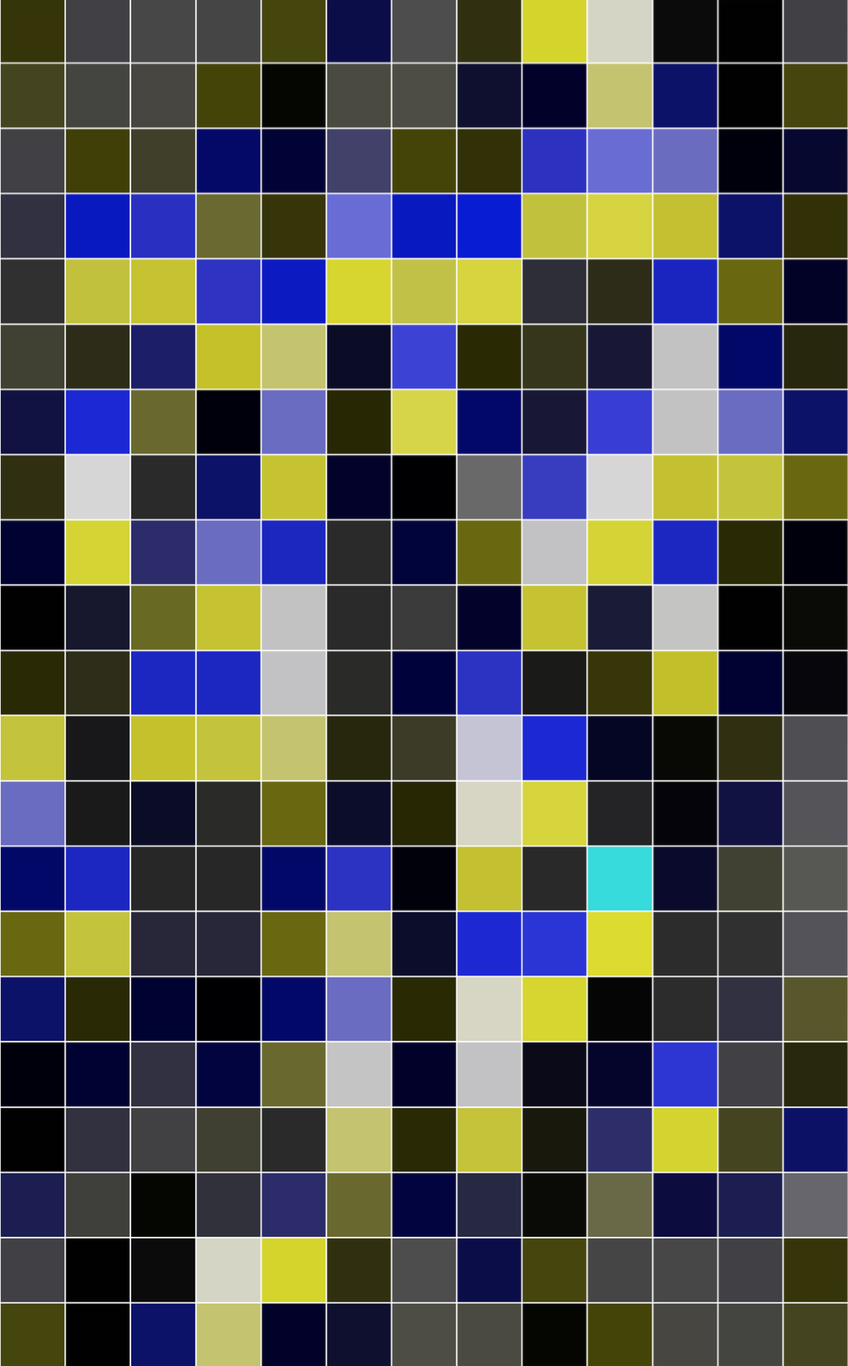
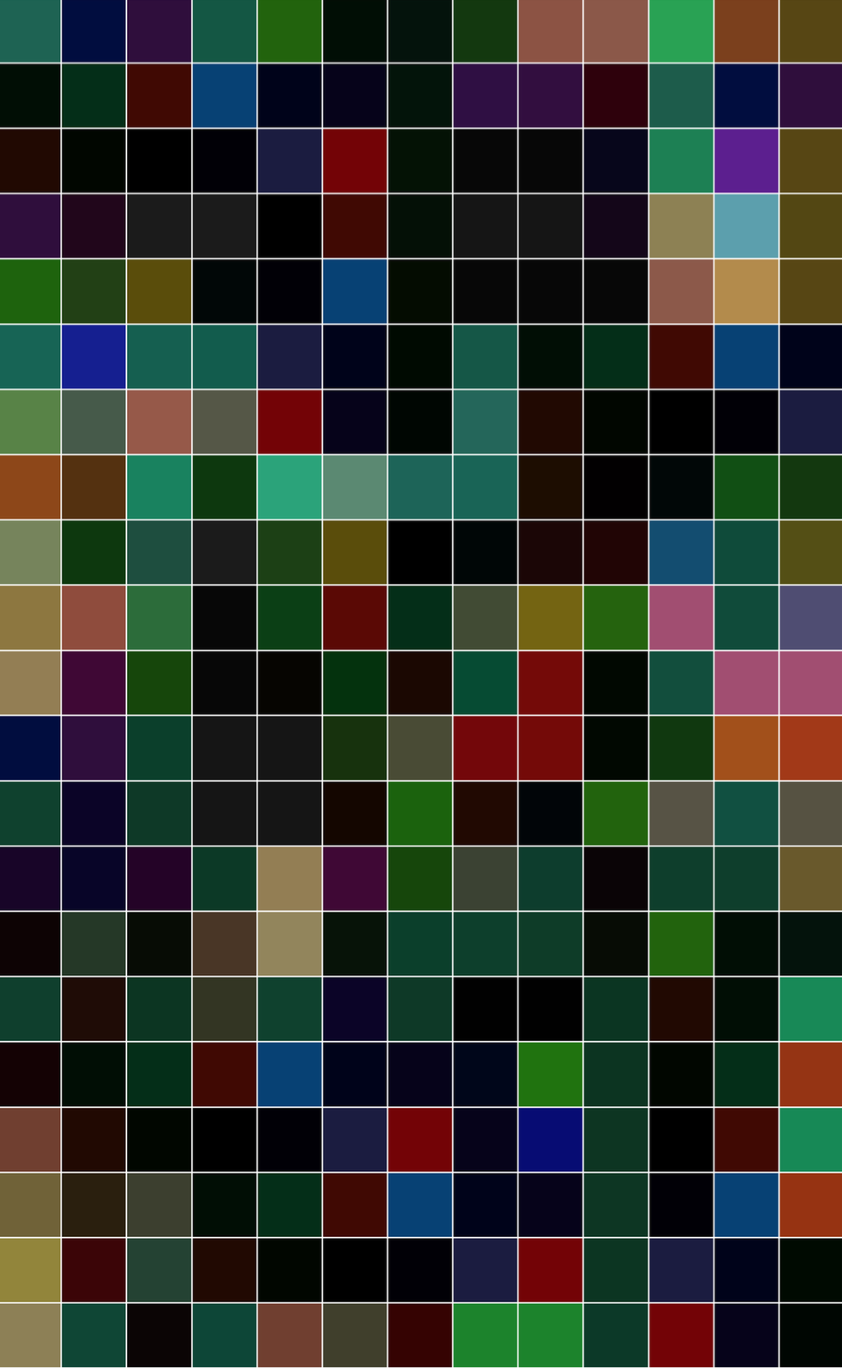
Finally, my current project, Lost Grids, which I began in 2017, puts forward an apparatus for manufacturing and juxtaposing two incommensurate planes: a plane of associations forged by citing and pairing pictures and texts from the cultural archive and a plane of corresponding visual surfaces produced by intermixing these citations through a creative misuse of digital code. The latter, which take the form of multi-colored grids, are formed by selecting texts from the plane of associations and by then entering the language of the texts directly into the underlying digital code-bed of the images. The grids are ultimately created from a magnification of the specific visual glitches that result from this technical intervention. In 2019, the work in progress was printed and exhibited as two separate and parallel series (of grids and image-text networks) along opposite walls of a gallery in order to emphasize the interval and incommensurability between the ornamental forms and their corresponding conceptual contents. More information about my project can be found at Lost Grids.

 
[Image from the unpublished manuscript]
[Image from the unpublished manuscript]


Research Residency at MACBA CED


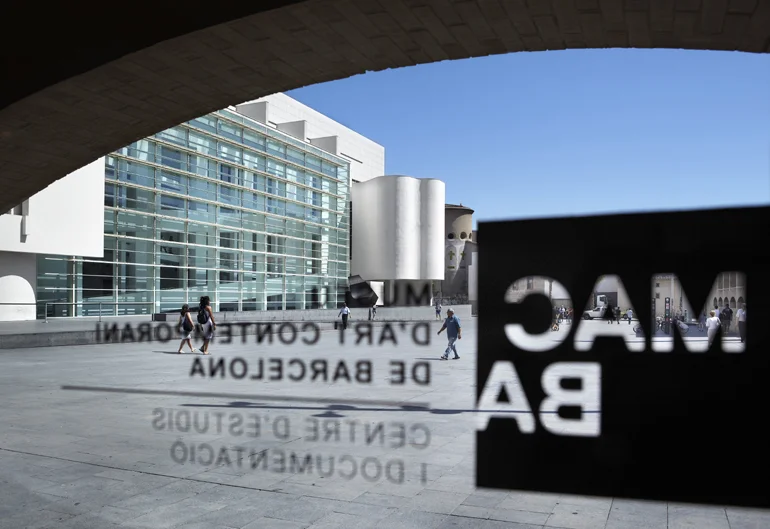
Front of MACBA Centre d’Estudis i Documentació (MACBA CED)

View of the Barcelona Museum of Contemporary Art (MACBA) from MACBA Centre d’Estudis i Documentació (CED)

View of the Barcelona Museum of Contemporary Art (MACBA) from MACBA Centre d’Estudis i Documentació (CED)

Today (January 11, 2019) I concluded my Fall/Winter residency at the Barcelona Museum of Contemporary Art Research Center (MACBA CED), which offered a great support for the research side of my Lost Grids project. The residency provided a work space with desk and computer; extensive research support from the MACBA CED library staff; access to the library and archive collections, which have excellent resources related to contemporary and conceptual art; and finally a “friend pass” to the Museum.

MACBA tweet

Project Blurb:

Peter Freund, Lost Grids
Inspired by the incommensurability of surface and depth, Peter Freund generates digital materials by hacking the underlying code of iconic photography with the use of poetic, critical and quotidian texts. His project will ultimately result in a set of variegated grid prints that harness the impulses of conceptual art in exploring the history and politics of the grid, from the renaissance perspective machine and the geometrical configurations of cartography, architecture and design to the abstract, gridded constructions of modern and contemporary art and the pixel system undergirding the raster image. The radical ornamentalism of Freund’s prints presents an interventionist strategy in a politics of enjoyment.

The MACBA CED staff were a tremendous help; big thanks to Noemí Mases, who was always suggesting new materials for research from my vaguest of inquiries! Early on, I asked Andrea Ferraris if she could track down the obscure metagraph, “The Death of J.H.,” by Guy Debord referenced in his and Gil Wolman’s A User’s Guide to Détournement in which “125 classified ads of bars-for-sale express a suicide more strikingly than the newspaper articles that recount it.” For years I’d assumed with some enjoyment that the work was a creative fiction, that it never actually existed outside a conceptual dream. But then, many weeks after my inquiry, at the end of her quiet persistence, Andrea showed up at my desk with two copies of the artwork!

Cover image, A User’s Guide to Détournement

Cover image, A User’s Guide to Détournement

Guy Debord, The Death of J.H.

Over the course of my MACBA CED residency, the project progressed in conjunction with an artist residency at the Werner Thöni Artspace in Gracia that provided me with a studio. The research process produced several intricate networks of associations based on dialectical pairings of images and texts from disparate sources. For my work-in-progress exhibit at the WTA gallery, these networks were displayed along one wall and the corresponding grid visuals for each network on the other. The project concept developed to this point:

< LOST GRIDS

The Lost Grids comprise, first and foremost, a generative apparatus (or “conceptual machine”) for producing and juxtaposing two incommensurate planes: a plane of associations forged by citing and pairing pictures and texts from the cultural archive and a plane of corresponding visual surfaces produced by intermixing these citations through a creative misuse of digital code.

The first plane is made up of curated networks of image-text associations organized into thematic sets. Each set’s coherence ranges from argumentative assertions to ideas that drift in and out of oblique and problematic linkages. In this way, each associative ensemble presents a connective logic intended to mimic without credibly delivering the lucid and over-reasoned bond of illustration or explication. The overarching aim is to loosen, recalibrate, and overcharge the valences of each element and to assert their altered potentiality within a larger associative network in which the elements have been positioned.

The second plane consists of visual surfaces that take the form of variegated grids. Each grid – neither text nor quite image – is produced by a process in which a text – philosophical, poetic, critical, or quotidian – is selected from the associative network and then entered directly into the underlying code-bed of its corresponding image. A disruption in the image consequently results, and out of this visible glitch a palette of pixel patterns is assembled, from which the final grid is ultimately created. Standing opposite the grid as its progeny, this privileged image-text pair, plucked from its network, indicates the single point of contact with the larger associative network, which otherwise remains aloof from the colorful grid. Such is the wide interval between the parallel series of grids and corresponding networks that presents the project’s conceptual core.

The Lost Grids machinery begins its series of productions with picture citations loosely associated with hair: Marx’s beard, Ana Mendieta’s cosmetic hair implants, Julia Pastrana (the “bearded lady”), contemporary beard fashion, the 1967 Patterson/Gimlin Sasquatch film, Pierre Huyghe’s “Untitled (Human Mask),” Jeff Koons’ “Michael Jackson and Bubbles,” the Bolivian military’s hand stroking the head of Che Guevara’s corpse, Joseph Beuys’s intimate handling of the dead hare, Méret Oppenheim’s fur cup, a hairy exchange from An Andalusian Dog, Courbet’s “Origin of the World.”

The first three grids:

&lt; 000_Marx’s_Beard &gt;

< 000_Marx’s_Beard >

&lt; 001_Arrival_of_the_Train &gt;

< 001_Arrival_of_the_Train >

&lt; 002_The_House_Is_Black &gt;

< 002_The_House_Is_Black >

A sampling of the artists + writers that found a place in the Lost Grids based on my research at MACBA CED:

Ana Mendieta
Carl Andre
Pierre Huyghe
Carolee Schneeman
Gordon Matta-Clark
Absalon
Eyal Weisman (Forensic Architecture)
Lim Tsay Chuen
Fred Wilson
Andrea Pozzo
Gregor Schneider
Forough Farrokhzad
Joseph Beuys
Vito Acconci
Filippo Brunelleschi
Hanne Darboven
Jane Benson
Jordi Colomer
Hito Steyerl
Sol Lewitt
Anni Albers
Abby Warburg

Marcel Duchamp
Emily Dickenson
Gaston Bachelard
Superstudio
Le Corbusier
The Situationist International
Costant
Rem Koolhaas
Ildefons Cerdà i Sunyer
René Magritte
Albrecht Dürer
Bertolt Brecht
Rossalind Krauss
Jacques Lacan
Jean-Luc Godard
Girard Desargues
Abraham Artelius
Martin Cortes
John Rennie Short
Hélène Cixous
Georges Didi-Huberman
Giuseppe Pinot-Gallizio

In addition to the terrific experience making use of the MACBA CED library, I enjoyed talking with the other resident artists, including Joan Morey and Blanca Garcia, who had exhibitions I was able to attend during our overlapping time at MACBA.